

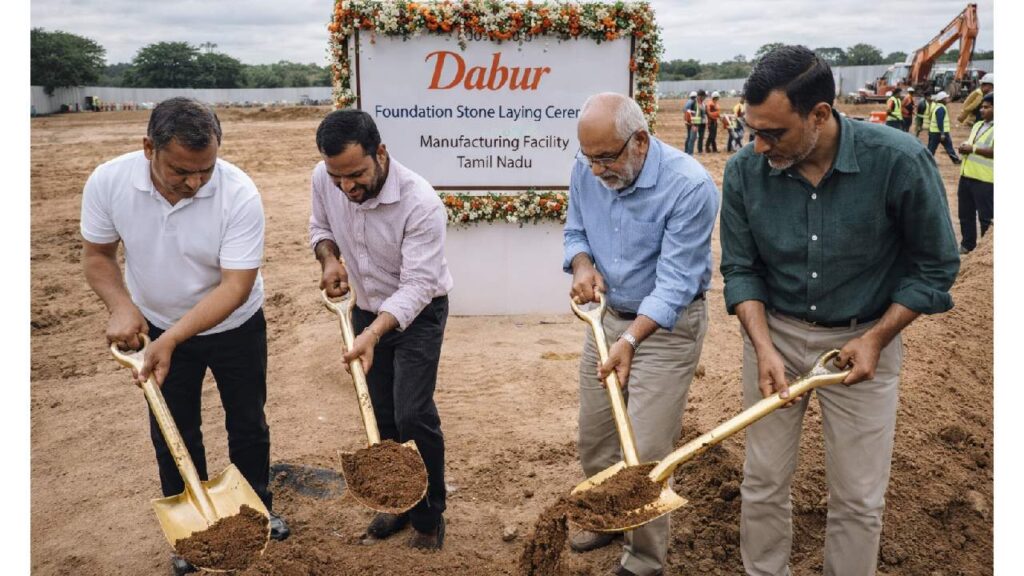
Dabur India Ltd has initiated construction of a new manufacturing facility in Tindivanam, marking its formal expansion into South Indian manufacturing operations. The groundbreaking ceremony was virtually inaugurated by M. K. Stalin, Chief Minister of Tamil Nadu, with senior state officials in attendance, including T. R. B. Rajaa.
The project represents a total committed investment of approximately Rs 400 crore, with nearly one third of the capital already deployed for the first phase of execution.
Strategic Location and Infrastructure
The new facility is being developed at the SIPCOT Food Park, a state supported industrial cluster designed to accelerate food and FMCG manufacturing.
The site is positioned to:
- Shorten supply chain distances to South Indian markets
- Improve inventory responsiveness and regional distribution efficiency
- Reduce inter state logistics costs
- Strengthen manufacturing redundancy within Dabur’s national network
The move signals a structural shift toward decentralized production aligned with demand clusters.
Phase I Product Focus
During the initial phase, the Tindivanam plant will manufacture high volume personal care SKUs, including:
- Dabur Red Toothpaste
- Meswak toothpaste
- Dabur Gulabari
- Vatika Hair Oil
Subsequent scale up plans indicate addition of beverage and hair care lines such as Réal Juices and Amla Hair Oil, positioning the plant as a multi category FMCG production hub.
Operational and Supply Chain Implications
From a manufacturing strategy perspective, the facility supports:
- Regionalized production to mitigate freight volatility
- Improved service levels in southern distribution corridors
- Capacity balancing across northern and western plants
- Enhanced responsiveness to state specific demand patterns
Tamil Nadu’s industrial ecosystem offers established utilities infrastructure, skilled workforce availability, and policy support for large scale FMCG investment.
Economic and Ecosystem Impact
Beyond production capacity, the project is expected to generate direct and indirect employment opportunities, strengthen ancillary supplier networks, and support regional industrial development.
For contract manufacturers and raw material suppliers operating in southern India, Dabur’s presence may create incremental procurement and vendor development opportunities within packaging, actives, flavors, and processing inputs.
Conclusion
The Rs 400 crore Tindivanam facility reflects Dabur’s long term strategy to optimize supply chain geography and deepen its manufacturing footprint in high consumption southern markets. As FMCG players continue shifting toward distributed production architectures, such investments highlight the increasing strategic importance of regional industrial clusters in India’s consumer goods landscape.